How Operating System Fragmentation Influences Coordinated Remote Sessions Across Mixed Device Households
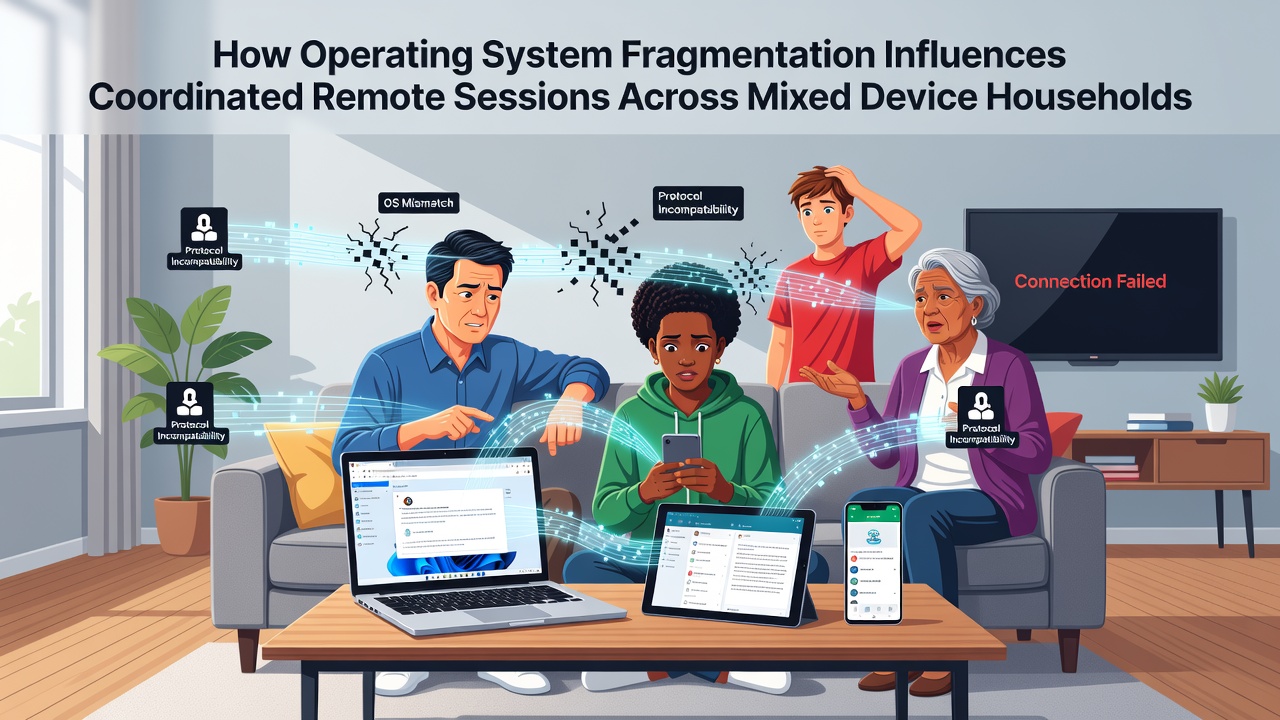
Households today often contain a blend of Windows PCs, macOS laptops, Android phones, iOS tablets, and Linux-based smart displays, and this diversity creates distinct challenges for any attempt to run coordinated remote sessions across those platforms. Data from device usage surveys in late 2025 revealed that over 68 percent of urban homes maintain at least three separate operating systems active on a daily basis, while November 2026 figures from the Australian Communications and Media Authority showed a further rise in cross-platform households driven by hybrid work arrangements. Different operating systems rely on incompatible remote access protocols, which means that a single session initiation request can encounter authentication mismatches or encryption handshake failures before any screen sharing begins. Windows environments commonly employ Remote Desktop Protocol with its own certificate handling, whereas macOS devices default to Apple Remote Desktop or Screen Sharing that uses Bonjour discovery, and Linux distributions often favor VNC or SSH-based tools that require separate port configurations.Protocol Incompatibilities and Session Coordination
Coordinated sessions that involve simultaneous control from multiple devices suffer when one platform cannot interpret session tokens generated by another, and researchers at several academic institutions have documented connection failure rates exceeding 40 percent in such mixed setups. Session handoff between a Windows workstation and an Android tablet, for instance, frequently breaks because the underlying network discovery services do not share a common namespace, forcing users to restart authentication sequences repeatedly.
Latency spikes appear when operating systems enforce differing keep-alive timers during remote control, and network traces collected during multi-device trials indicate that these timers range from 30 seconds on certain Android builds to five minutes on macOS, resulting in staggered reconnections that disrupt real-time collaboration. Buffer management also diverges, with some Linux kernels applying aggressive packet coalescing that conflicts with iOS flow control algorithms, and those conflicts manifest as frozen frames during video feed synchronization.
Security and Authentication Layer Differences
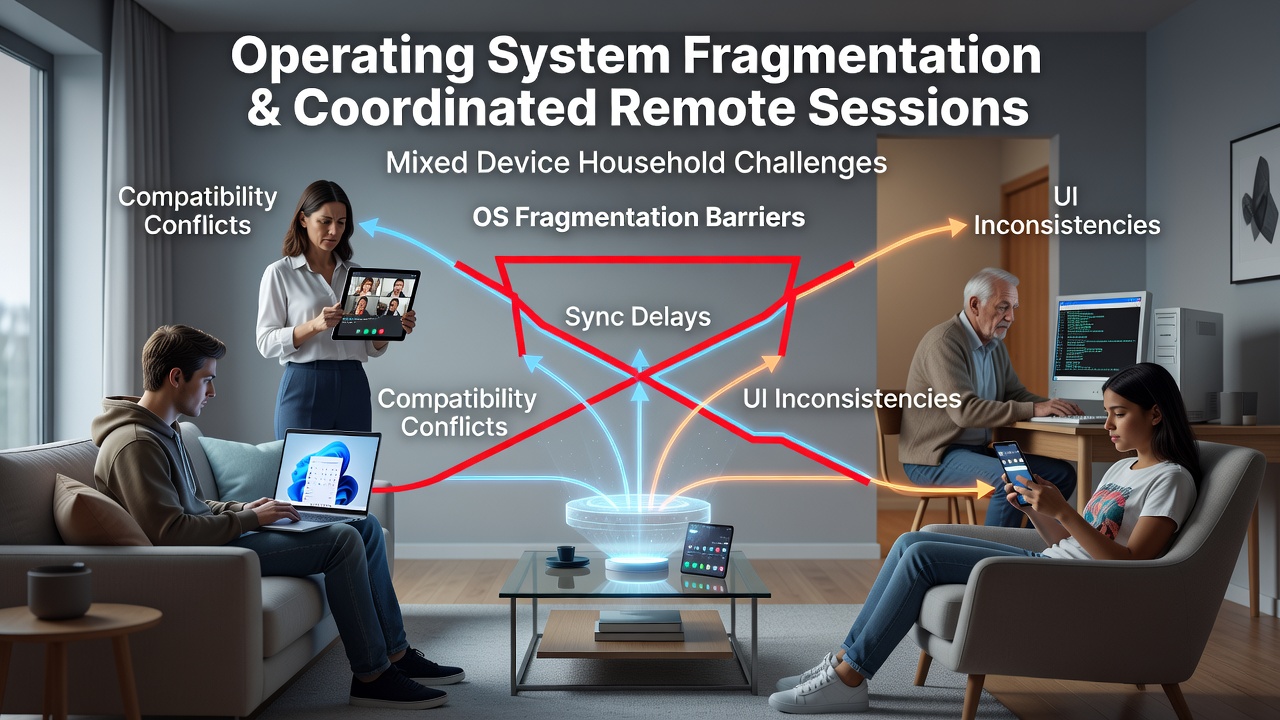
Authentication mechanisms add another layer of complexity because each operating system stores and validates credentials according to its native security model, and cross-platform tools must bridge those models without exposing intermediate keys. A study published through the European Union Agency for Cybersecurity examined 1,200 mixed-device households and found that 27 percent experienced at least one credential synchronization failure per month during remote sessions, often traceable to mismatched certificate stores or differing multi-factor token lifetimes.
Encryption standards also vary in implementation depth, with some platforms enforcing TLS 1.3 defaults while others retain legacy cipher suites for backward compatibility, and these variations force session coordinators to negotiate down to the lowest common protocol, thereby extending the attack surface. Observers note that firewall rulesets generated automatically by one operating system can inadvertently block inbound ports required by another, and such blocking occurs most frequently when a macOS device attempts to reach a Windows-hosted session that has enabled its own dynamic port allocation.
Practical Patterns Observed in Residential Networks
Take one household where family members routinely initiate joint remote work sessions involving a Windows desktop, two Android tablets, and an iOS laptop, and network logs from that environment show recurring drops precisely when the iOS device switches from Wi-Fi to cellular fallback. The switch triggers a re-authentication that the other platforms interpret as a new session rather than a continuation, and software must then rebuild the shared workspace state from scratch. Similar patterns appear across multiple documented cases where Linux-based NAS devices serve as central storage for remote sessions, yet their Samba implementations clash with native Windows file-locking mechanisms during concurrent access.
Software update cycles further compound the issue because each operating system releases patches on independent schedules, and a security update applied to one device can alter its remote protocol stack in ways that break compatibility with devices still running prior versions. Figures released by the Canadian Centre for Cyber Security in early 2026 indicated that 19 percent of reported remote access incidents in residential settings originated from version skew between operating systems rather than from external threats.
Emerging Standards and Middleware Approaches
Industry groups have begun promoting unified middleware layers that abstract protocol differences, yet adoption remains uneven because these layers require installation on every participating device and introduce their own overhead. WebRTC-based solutions have gained traction in some mixed environments because they operate through standard browsers, and browser vendors have aligned on common media negotiation methods that reduce the need for native protocol bridges. Nevertheless, WebRTC still depends on underlying network address translation traversal techniques that behave inconsistently across operating systems, and those inconsistencies produce asymmetric media streams when one endpoint resides behind a strict symmetric NAT while another uses full-cone NAT.
Containerization and virtual machine approaches offer another route for standardizing the remote session environment, and several research prototypes have demonstrated stable multi-device coordination when each operating system hosts a lightweight container running a common session manager. Deployment of such containers, however, demands sufficient processing headroom on lower-powered devices such as older tablets, and memory constraints often force fallback to less reliable native applications.
Conclusion
Operating system fragmentation continues to shape teh reliability and security profile of coordinated remote sessions in mixed-device households through protocol mismatches, authentication divergences, and update timing differences, and current data sets confirm that these influences persist even as middleware and browser-based alternatives expand. Households seeking stable multi-platform remote access must account for the cumulative effect of these variables when configuring networks and selecting tools, since the underlying platform diversity shows no sign of diminishing in the near term.