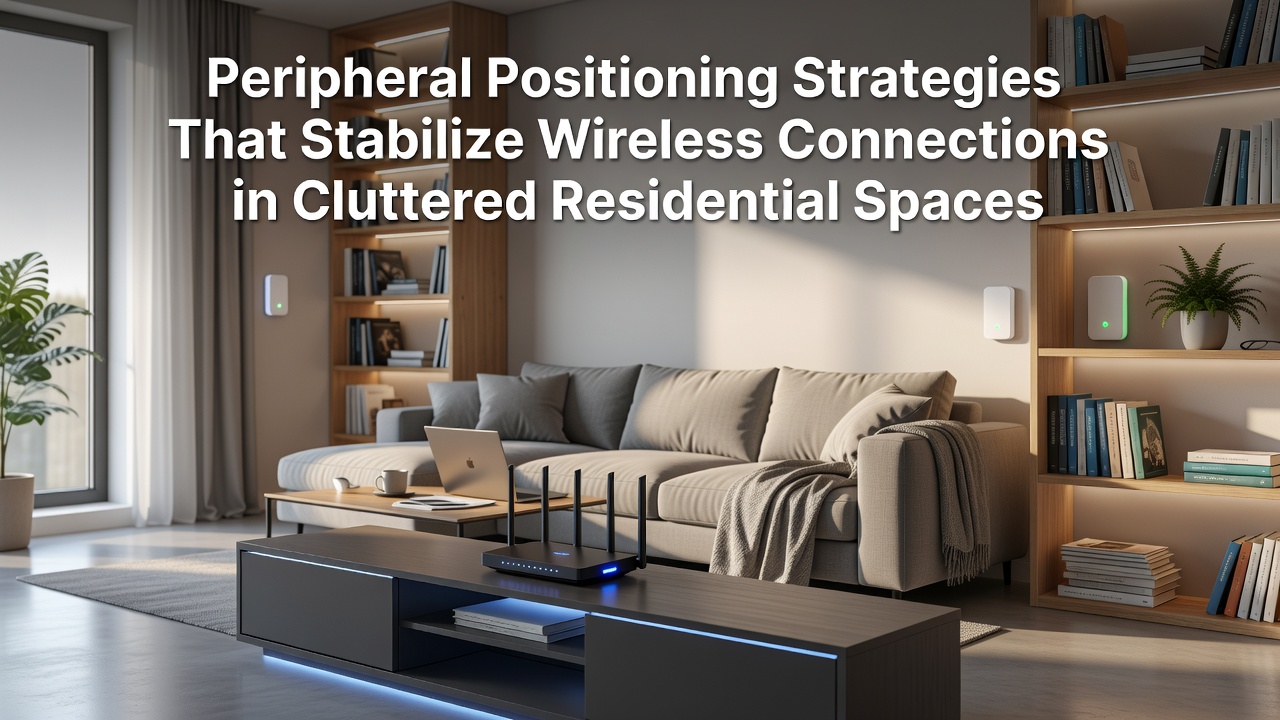
Peripheral Positioning Strategies That Stabilize Wireless Connections in Cluttered Residential Spaces
Wireless connections in residential environments face consistent challenges from everyday clutter, and positioning strategies for routers along with connected peripherals play a central role in maintaining signal stability. Data from multiple studies shows that furniture, walls, and electronic devices can attenuate radio frequencies used by Wi-Fi networks, particularly in the 2.4 GHz and 5 GHz bands. Observers note that strategic placement reduces packet loss and improves throughput without requiring additional hardware investments.
Signal Attenuation Patterns in Home Settings
Cluttered spaces create multiple reflection and absorption points that disrupt line-of-sight paths between access points and client devices. Research indicates that metal appliances and dense bookshelves absorb higher-frequency signals more readily than lower ones, while water-filled objects such as aquariums or plant pots introduce additional attenuation. According to the Federal Communications Commission, residential deployments often operate near the edge of reliable coverage when devices sit behind multiple layers of obstruction. Those who map signal strength across floor plans frequently record drops of 10 to 20 dB when moving a receiver from an open hallway into a room filled with storage units.
Router Elevation and Central Placement Approaches
Placing the primary router at a higher elevation, typically on a shelf or mounted near ceiling level, allows signals to clear low-lying obstacles more effectively. Engineers have documented improved coverage radii when routers occupy central locations within the main living area rather than tucked into corners or behind televisions. Multi-story homes benefit from positioning the device on an upper floor when most usage occurs downstairs, because downward signal propagation often outperforms upward transmission through floor materials. Data shows that even modest shifts of one meter horizontally or vertically can change received signal strength by several decibels in environments containing dense furnishings.
Peripheral Device Orientation Tactics
Wireless peripherals such as printers, smart speakers, and security cameras require similar attention to their surroundings. Positioning these units away from microwave ovens, cordless phone bases, and thick window treatments prevents localized interference that fragments the network. Technicians who test antenna angles on client devices report that small rotations of 30 to 45 degrees frequently restore stable links when the original orientation faced a dense cabinet or refrigerator. In October 2026, updated residential spectrum measurements released by the Australian Communications and Media Authority highlighted how seasonal increases in indoor clutter, including holiday decorations, further emphasize the need for periodic repositioning checks.
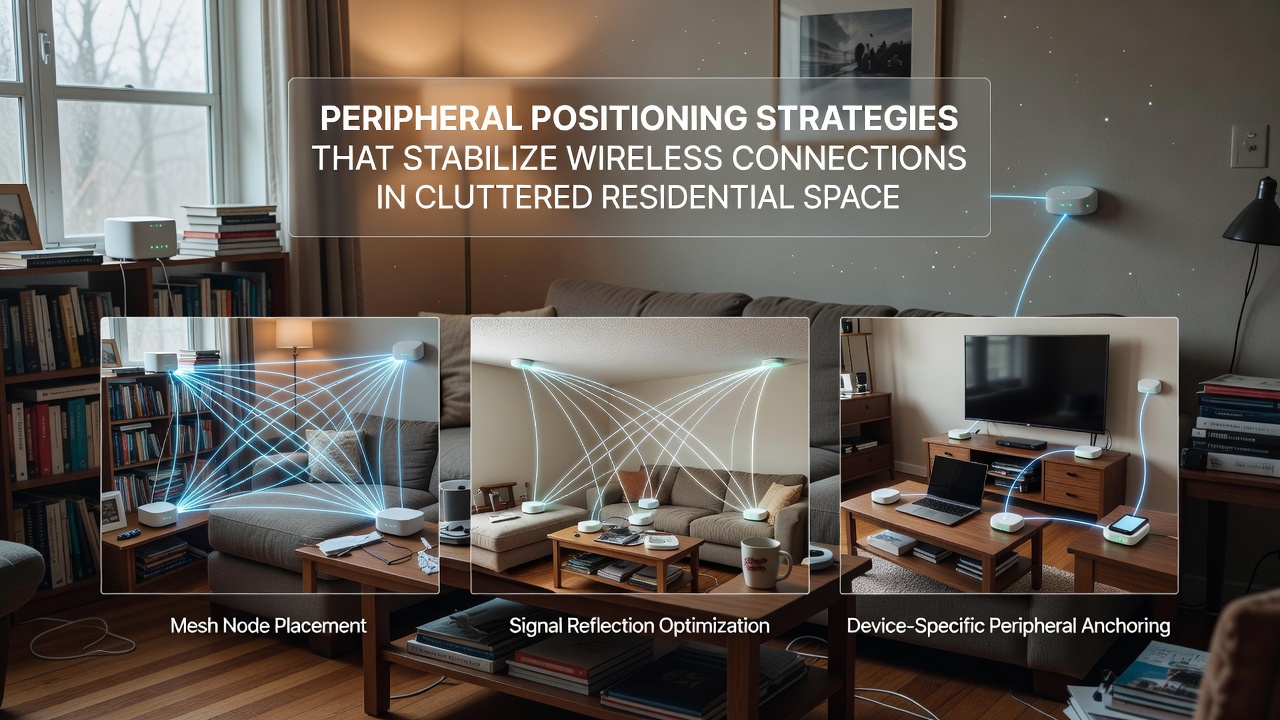
Mesh node placement follows comparable rules yet introduces additional variables. Nodes positioned at mid-height along interior walls maintain better interconnectivity than those placed on the floor or behind large screens. Studies tracking throughput across mesh systems reveal that maintaining at least one meter of clearance around each node reduces self-interference and supports consistent handoff between access points.
Material and Environmental Considerations
Different building materials affect signal behavior in predictable ways. Drywall and wooden framing permit greater penetration than brick, concrete, or plaster reinforced with metal lath. Residents who rearrange furniture away from direct paths between routers and work areas often observe measurable improvements in connection reliability. Environmental factors such as seasonal humidity variations can also influence signal propagation, although the primary mitigation remains physical repositioning rather than environmental control. Figures from academic field tests conducted in urban apartments confirm that clearing a 30-centimeter radius around antennas yields the most noticeable stabilization in cluttered conditions.
Integration with Existing Network Infrastructure
Positioning strategies integrate directly with channel selection and power settings already available on most consumer routers. Devices moved into clearer sight lines experience fewer retransmissions, which in turn lowers latency for real-time applications. Network administrators who combine elevated router placement with strategic peripheral spacing report sustained performance across multiple simultaneous connections. Evidence from controlled residential trials demonstrates that these adjustments alone can extend usable coverage by 15 to 25 percent in typical multi-room layouts without altering transmit power or adding repeaters.
Conclusion
Effective peripheral positioning relies on consistent application of elevation, clearance, and orientation principles within the constraints of each residential layout. Measurements collected across varied home types indicate that incremental adjustments produce cumulative gains in connection stability. Continued attention to these placement details supports reliable wireless performance as device density increases in everyday living spaces.