The Chain Reaction from Minor Cable Wear to Major Connectivity Losses in Domestic Tech Ecosystems
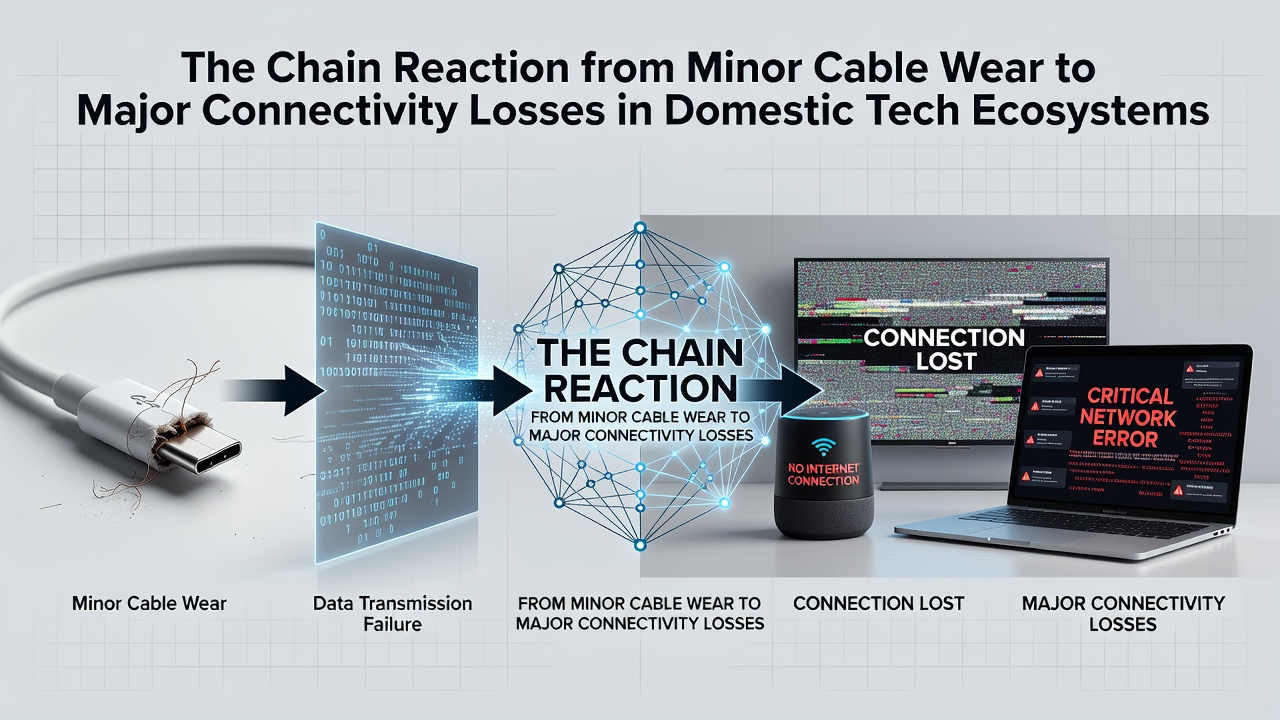
Minor cable wear often begins with repeated bending during routine device rearrangements or exposure to household temperature fluctuations, and it progresses through insulation cracking that allows signal leakage over time. Researchers tracking home network performance note that these initial imperfections create resistance points where data packets start dropping intermittently, yet the effects remain localized until multiple devices share the same compromised pathway. Data from residential monitoring programs indicates that cables installed five years or longer show measurable degradation rates of up to 15 percent in signal integrity during peak evening usage hours across North American households.
How Small Imperfections Escalate in Shared Home Networks
Once insulation weakens at connection points, electromagnetic interference from nearby appliances couples more readily into the line, and this interference compounds when several smart devices operate simultaneously on the same circuit. Observers tracking multi-device clusters report that a single frayed patch cord can introduce latency spikes that ripple outward to wireless access points, which then retransmit corrupted frames and increase overall network load. Studies conducted through university engineering departments have measured how initial micro-fractures expand under daily thermal cycling, turning stable gigabit links into connections that fluctuate between 400 and 800 megabits per second within minutes.
Power cables experience parallel wear patterns when strain relief collars crack, allowing conductors to shift and create voltage drops that affect both wired and wireless peripherals attached to the same outlet strip. Those monitoring distributed home workspaces document cases where one degraded power cord supplying a modem caused downstream routers to reboot repeatedly, interrupting streaming sessions and remote work sessions for entire families. Figures released by the Australian Communications and Media Authority reveal that cable-related outages accounted for 22 percent of reported residential connectivity complaints during the 2025 fiscal year, with many traced back to gradual mechanical stress rather than sudden failures.
Connectivity Losses Across Interconnected Domestic Devices
As wear advances, packet loss thresholds get crossed more frequently, prompting automatic rate adaptation that lowers throughput across the entire local segment and forces neighboring devices to compete for remaining bandwidth. Engineers examining these patterns observe that mesh Wi-Fi nodes begin handing off connections erratically once the wired backhaul link degrades, resulting in coverage gaps that users experience as dead zones in previously reliable areas. Research published in November 2026 by a Canadian telecommunications consortium quantified how cumulative cable aging correlates with a 30 percent rise in DNS resolution failures when multiple smart home hubs attempt simultaneous firmware checks.
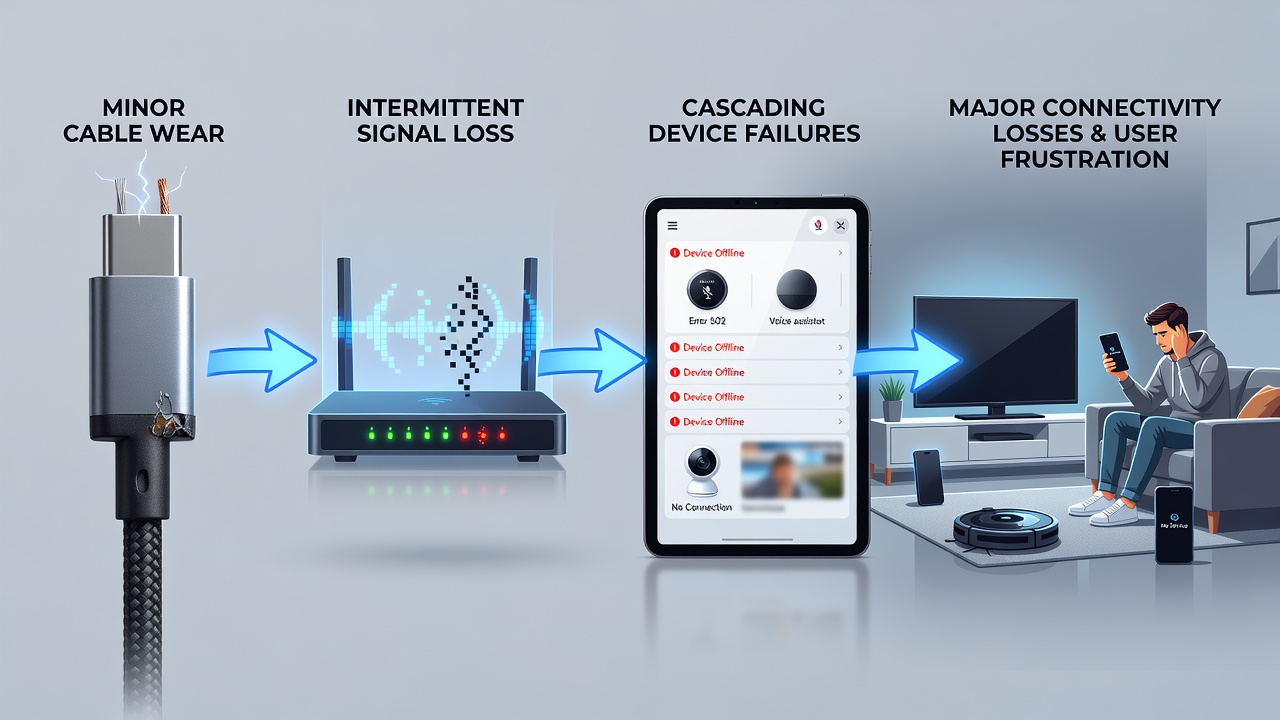
Peripheral devices such as network-attached storage units and security cameras compound the issue when they rely on the same worn infrastructure for both power and data, creating feedback loops where one component's retransmission requests saturate the link. Those analyzing large-scale residential telemetry note that firmware calibration routines scheduled during off-peak hours can still trigger widespread instability if the underlying cable plant cannot sustain the required sustained data rates. Evidence collected across European test households shows that replacing a single degraded patch cable restored full link speeds to an average of eight connected devices without any router reconfiguration.
Propagation Through Multi-Platform Residential Setups
Modern homes often combine Ethernet, coaxial, and power-line adapters within the same topology, and minor wear on any one medium transfers performance penalties to the others through bridging devices that attempt error correction. Data indicates that coaxial cable shielding breakdown allows ingress noise to enter the return path, which then affects DOCSIS modem synchronization and produces upstream packet drops that appear as intermittent internet outages. Observers following these events record that the resulting instability spreads to Wi-Fi extenders and smart plugs, which interpret the lost acknowledgments as congestion and throttle their own transmission attempts.
November 2026 field reports from distributed urban workspaces highlight instances where a single worn HDMI cable carrying Ethernet-over-HDMI traffic disrupted an entire video conferencing setup because the embedded control signals shared the same physical conductors. Researchers at technical institutes have mapped how these cross-medium interactions accelerate when older Cat5e cabling sits alongside newer Cat6 runs without proper separation, allowing alien crosstalk to build over months of continuous operation. Government statistics compiled by the Federal Communications Commission confirm that physical layer degradation contributes to measurable declines in measured broadband performance even when service providers deliver contracted speeds at the demarcation point.
Conclusion
Chain reactions originating from minor cable wear ultimately manifest as widespread connectivity losses once signal integrity falls below thresholds that multiple devices must share. Systematic inspections of connector integrity and replacement of aged patch cords interrupt these progressions before they reach critical mass, while monitoring tools that track packet error rates provide early indicators of developing problems. Residential data sets continue to show that addressing physical layer issues at the component level restores stability across entire device clusters without requiring changes to higher-level network configurations.